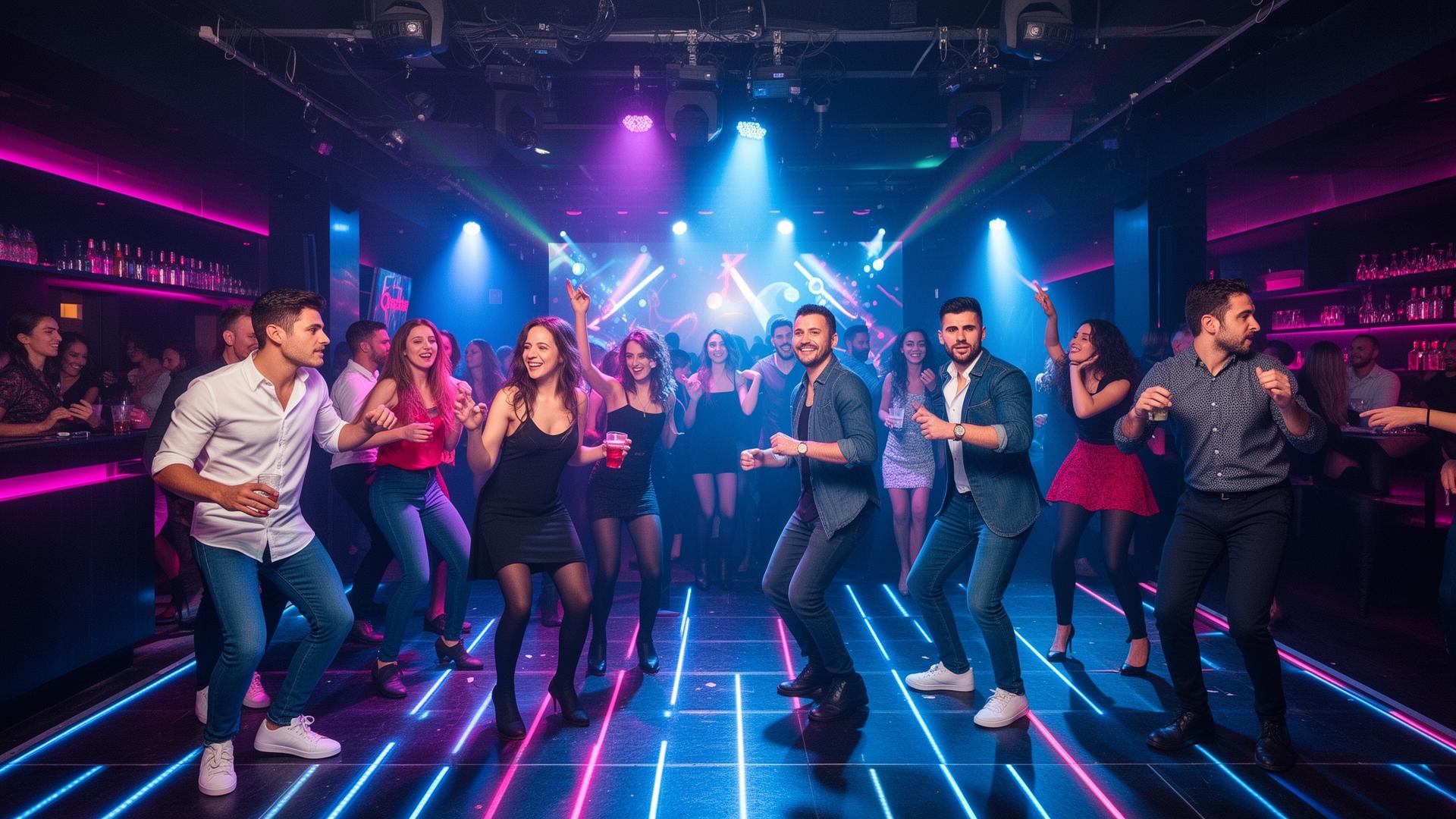
A simple, beginner-friendly guide to dancing at clubs and bars in San Diego. Learn natural movement, rhythm basics, and easy steps you can use anywhere.
Practice rhythm and relaxed movement with private nightclub dance lessons in San Diego at Infinity Dance Sport Center in Kearny Mesa.
6 quick questions. Get Noe's Dance Prescription.
If you've ever stepped onto a club or bar dance floor and thought,
"I have no idea what I'm doing,"
you're not alone.
Most adults never learned how to dance socially. We learned math. We learned how to type. No one pulled us aside in grade school and said, "Here's how to move when music is loud and people are watching."
So now you're grown, living in San Diego — home to Gaslamp nightlife, PB bars, Latin clubs, EDM nights, rooftop parties — and you want to feel natural dancing at any of them.
Good news: you don't need big moves, crazy rhythm, or choreography. You just need a few simple building blocks that make dancing feel easy and comfortable.
Let's make that happen.
🎉 Why Club Dancing Feels Hard (But Doesn't Have to Be)
Club dancing is challenging for beginners because:
- There's no set choreography
- The music is loud
- The dance floor is crowded
- You're not sure what your body should be doing
- Everyone else seems to "just know" how to move
The truth is… most people are faking it.
Club dancing is about natural movement, not perfect technique.
You're not trying to perform.
You're just trying to feel in tune with the music and your own body.
And that's something anyone can learn.
Keep It Simple: Your Basic Club Groove
The simplest movement — and the one most people do — is a small weight shift back and forth.
Try this:
- Stand tall but relaxed
- Shift your weight from one foot to the other
- Let your knees soften slightly with each shift
- Add a gentle bounce on the beat
- Let your arms hang naturally by your sides
This alone works for:
- Hip-hop
- EDM
- Pop
- Funk
- House
- Reggaeton
- Top 40 playlists
And no one will think twice about it — because this is what the majority of good club dancers are doing.
Find the Beat (The Simple Way)
You don't need music theory.
You don't need rhythm training.
You just need one trick:
Listen for the "thump."
Most club music has a strong downbeat.
Your job is to move with it, not on top of it.
Here's the shortcut:
- Pause
- Let the music hit you
- Nod your head gently on every main beat
- Let your body follow the nod
This immediately makes your movement look in sync with the music — and therefore natural.
Add a Little Upper Body (But Keep It Small)
Club dancing lives in small movements, not big ones.
Here's what you can add without looking over-the-top:
- Shoulder rolls
- Gentle chest movements
- Small torso angles
- A little arm flow
- Controlled hand gestures
- Light head movements
Think of it as "seasoning," not the main dish.
A little goes a long way.
Add Simple Footwork When You're Ready
Here are beginner-safe patterns that always work:
✔ The Side Step
Step side → bring feet together → repeat
This works for nearly every genre of club music.
✔ The Forward-Back Step
Step forward → return → step back → return
Perfect for EDM build-ups or slower hip-hop beats.
✔ The Tap Step
Tap your foot lightly on the beat
Great for funk, disco-inspired songs, or pop.
✔ The Body Rock
Shift your weight with a slight forward/back groove
Simple, cool, and universally flattering.
Add Style Based on the Music
Each genre has a different feel:
✔ Hip-Hop
Grounded, relaxed, low movements
More groove, less bounce
✔ EDM / House
Smaller footwork, light torso movement
Bigger energy in the upper body, but smooth
✔ Latin Club (Salsa/Bachata fusion)
Hips + rhythm
Side steps work extremely well
✔ Pop / Top 40
Simple beat matching
Smooth weight shifts
✔ Reggaeton
Small, controlled hips
Relaxed knees and torso
Once you understand the basics of groove and beat, adapting becomes natural.
🌟 What to Avoid When Dancing at a Club
(These are the mistakes beginners make)
- Doing choreographed TikTok moves
- Overthinking footwork
- Making movements too big for crowded spaces
- Keeping your arms stiff
- Locking your knees
- Staring at the floor
- Trying to "perform" for the room
Club dancing is small, natural, and relaxed.
If it feels forced, it probably looks forced.
💡 Bonus: What to Do With Your Hands
Great question — every beginner asks this.
Here are options that always look natural:
- Light sway with your arms
- Fingers gently snapping on the beat
- One hand casually in a back pocket
- Light shoulder/arm flow
- Hand on a drink (controlled)
- Simple head nod with micro-hand gestures
Keep it chill.
Keep it small.
Keep it natural.
🎯 Want to Feel Comfortable Dancing at Clubs in San Diego?
If you want club dancing to feel natural — not stiff, awkward, or overwhelming — the Nightclub & Bar Dance Experience or the Solo Learning Experience gives you the tools to move with ease.
In 60 minutes, I'll teach you:
- How to groove naturally
- How to find and follow the beat
- How to move your upper body
- Easy footwork patterns
- How to dance comfortably in crowded spaces
- Style choices for Hip-Hop, EDM, Latin, Funk, and Pop
No partner required, no pressure.
Just movement that finally feels good.
📦 Ready to Keep Dancing?
After your Experience (2 one-hour classes), many dancers choose to continue with a Lesson Package:
- 4-Lesson Package ($328) — $82/lesson, valid for 2 months
- 8-Lesson Package ($616) — $77/lesson, valid for 2 months
These private sessions give you deeper skill development, priority scheduling, and the momentum to truly transform your dancing.
Ready to try it out? Our guide to where to dance in San Diego lists local Latin, swing, country and tango socials.
Frequently Asked Questions
How do I dance at a club without looking awkward?
Learn a few versatile moves you can do confidently rather than trying to freestyle everything. Our Nightclub Dancing lessons teach practical moves for pop, EDM, and hip-hop. Book the Nightclub Experience to get started.
What kind of dancing do people do at clubs?
Most club dancing is freestyle movement to the beat. Some clubs play Latin music where Salsa and Bachata are common. The key is learning body movement and rhythm that adapts to whatever the DJ plays.
Can you learn to dance at clubs if you have no rhythm?
Yes. Rhythm is a skill that develops with practice. Private lessons break down how to hear and move to different types of club music. Most people who think they have no rhythm simply have not been taught how to find and follow the beat.
What clubs in San Diego are good for dancing?
San Diego has diverse options from EDM venues in the Gaslamp to Latin clubs in various neighborhoods. Country bars like Moonshine Flats offer Two-Step dancing. Your best venue depends on what music and dance style you prefer.